Leo William Wright on The Big Bad Wolf: turning a fairy tale on its head
The stop motion animator behind our Best Student Animation winner on grotesque pigs, friendly wolves, motion control and why Plasticine is a nightmare.
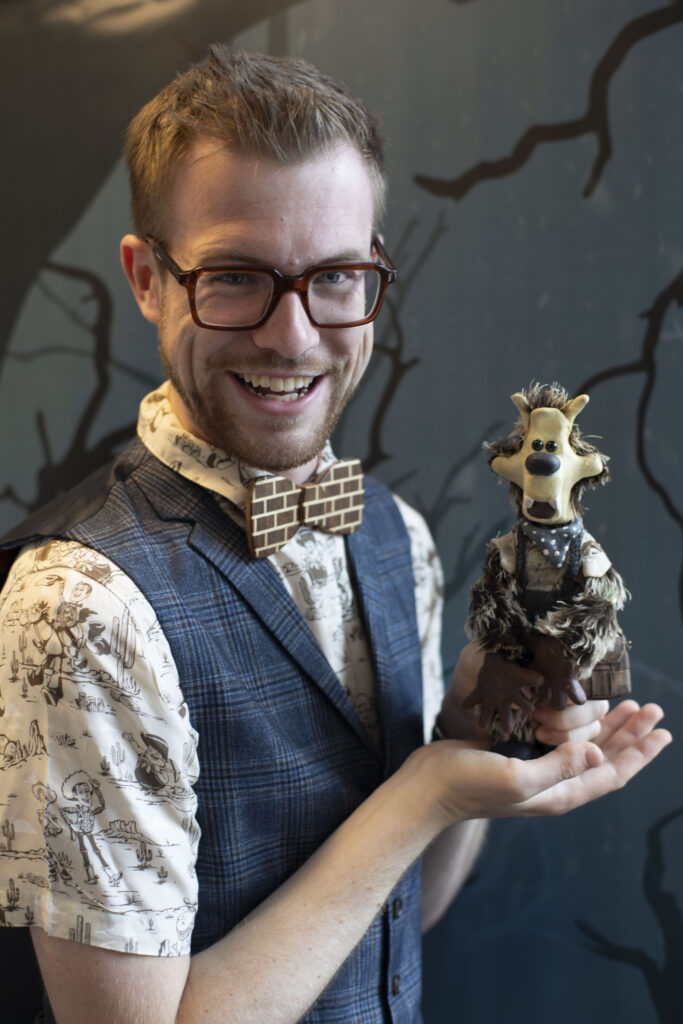
The Big Bad Wolf won Best Student Animation at the 2026 Stafford Film Festival. Leo William Wright made the stop motion short during a six month training course at Aardman’s Gas Ferry Road Studios, and it went on to be an Official Selection at the BFI London Film Festival 2025.
The film moves the three little pigs to the Black Country. After discovering the power of the humble brick, the pigs have built their way through the industrial revolution, and a young pig called Richmond befriends a wolf called Billy who is neither very big nor very bad, much to his father’s outrage.
Leo was in the room when the film screened at the Mitchell Arts Centre, and sat down with festival founder and director Michael S.U. Hudson afterwards to talk about character, camera and what comes next.
- Film
- The Big Bad Wolf
- Directed by
- Leo William Wright
- Award
- Winner, Best Student Animation, 2026
- Country
- United Kingdom
- Running time
- 5 minutes
The interview
In animation a lot of effort goes into the look of a character, and just as much into its personality. How did the design inform the personality, and the personality inform the design?
Wolves and pigs both already carry a lot of personality. I had been drawing cartoon pigs for quite some time, in the form of Porky Blinders [his pig twist on Peaky Blinders], and giving them caricatured personalities, before I even had the idea for the film. Pigs automatically come across as greedy, or big, or funny. So I took the tale of the three little pigs and the big bad wolf and asked whether I could flip it on its head, so the pigs are quite grotesque and the wolves are cute and friendly.
I designed the characters while I was at Aardman, with a lot of feedback from Félicie Haymoz, the character designer of Wes Anderson’s Fantastic Mr. Fox. We went backwards and forwards on Billy and Richmond, and landed on the designs you see in the film.
The story is tight and succinct. If you had more time and more resources, what would you have expanded?
When I was doing the storyboards there were a few parts I had to cut for timing. I would have built in more of the friendship between Billy and Richmond, more of them doing things together, and perhaps delved a bit deeper into the dad’s prejudice against wolves.
But I try not to focus too much on the things I’d change about this film. I think more about the next one: what I’ve learned from this, and what I’d do differently in technique, in character design, or with some of the limitations.
What other lessons did you take from it?
Plasticine is a nightmare to work with. It gets dirty, it gets dusty, you have to clean it and resculpt it over and over again. It’s a wonderful material and you can get a lot of expression from it, but it’s very time consuming, so my new film has less Plasticine in it.
It was also the first time I’d done larger effects like fire, and bigger set pieces, like a character running down the road. When you make these things yourself you always watch them back and think you could do better now. But as a whole piece, I’m still very proud of The Big Bad Wolf.
Everyone believes animators have total control, which is debatable. One of the most interesting things in animation is the cinematography. How did you develop the cinematic style, and were there references or influences we might recognise?
With all stop motion you draw everything out first, including the cinematography. Aardman were very accommodating. I was keen to have a long opening shot scrolling down the fence past the characters and the posters on the wall. That was done on motion control, so the camera moves frame by frame as I animate the characters.
I’m inspired by very long, winding shots. I particularly love The Polar Express and Robert Zemeckis’s motion capture films, which open with introductory shots that seem to go on forever. That’s quite hard to do in stop motion, but I’ve noticed a pattern in my last three films: they all open with long world building shots to bring people into the world. On set I worked with George Milburn and David Sproxton, one of the founders of Aardman, who helped with the cinematography and lighting to achieve the drawings in reality.
Have you seen your cinematic language evolve from when you started the project to now?
It’s constantly evolving. You work out what the limitations are, and then you can harness those limitations to make the film more successful. I’ve realised various things aren’t needed. I think less is more in a lot of cases with stop motion, whether that’s cinematography or music. The stories have to be quite small to be able to make a short film and afford it, so everything else should accommodate that.
One really engaging long tracking shot is probably enough. You don’t need two or three of them. I’m learning more and more that it’s about focusing on the characters and the story, and not using the camera to say, look, I can do this shot. You only use those deluxe shots when they’re really needed, perhaps at the opening and closing of a film.
Animation and live action used to cross over far more. Tim Burton, Wes Anderson and Guillermo del Toro still move between the two, but they established themselves in the 1990s and 2000s. Do you see your generation staying specialist, or will you move into live action too?
I definitely want to experiment with live action. I haven’t done it yet, but my next film has a live action intro and outro, and I really enjoyed doing that. There’s something satisfying about the speed of it, and many of my favourite films are live action, not necessarily animation. The thing I’ll struggle with is control, because I’m very used to the ultimate control of stop motion.
But I’m very excited to work with people. Sixty people have worked with me on my new film, and I’ve thoroughly enjoyed that hands on collaboration. I’d like to bring it to live action. Like Tim Burton, Wes Anderson or Guillermo del Toro, if I do live action I want it to still feel animated and otherworldly.
When I have an idea I always ask whether animation suits it as a medium. If you’re going to make a film about a man walking down the road, you may as well do it in live action. If you’re going to make a film about a pig and a wolf becoming friends, it has to be animated.
Watch the trailer
The Big Bad Wolf won Best Student Animation at the 2026 Stafford Film Festival. Read the full credits on the film page and see every 2026 winner.