
Konna Thomson on Brown Sheep: truth, coverage and the scene that had to go
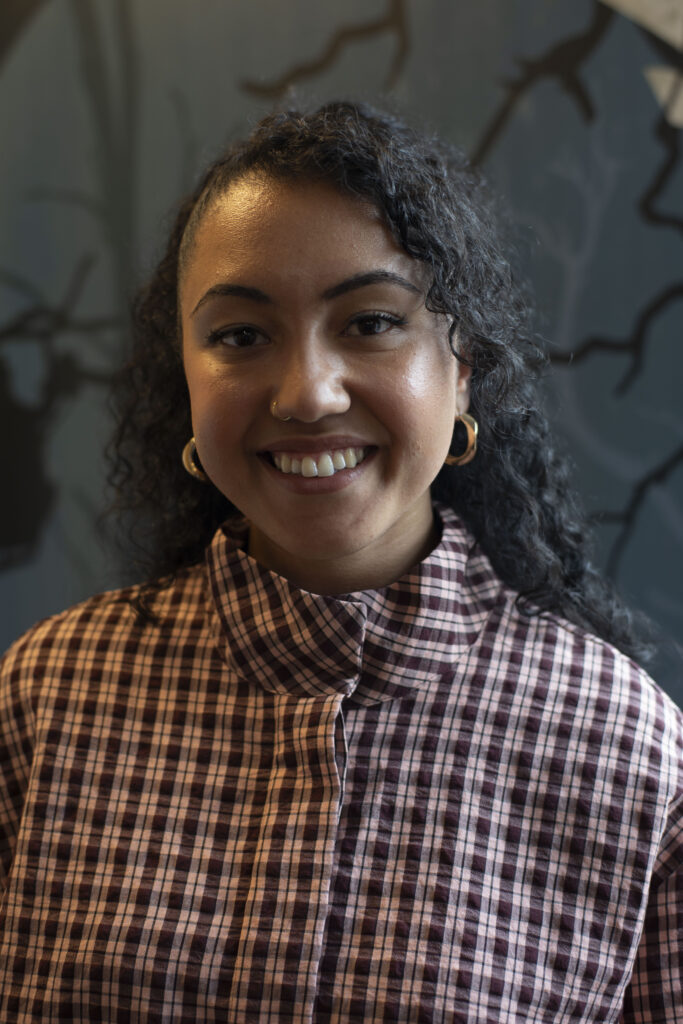
The writer and director of Brown Sheep on drawing from her own life, keeping school scenes honest, and what a good editor taught her about coverage.
Brown Sheep was nominated for Best Student Short Film at the 2026 Stafford Film Festival and screened at the Mitchell Arts Centre on 6 September. Written and directed by Konna Thomson at Manchester Film School, it follows sixteen year old Jamila as she navigates adolescence and natural hair confidence while reminiscing about her mother, at a predominantly white school.
Konna took questions from the audience after the screening, then sat down with festival founder and director Michael S.U. Hudson to go further into how the film was made and what it has meant to her.
- Film
- Brown Sheep
- Written and directed by
- Konna Thomson
- Produced by
- Sammy Wong
- Selection
- Nominee, Best Student Short Film, 2026
- Country
- United Kingdom
- Running time
- 13 minutes
- School
- Manchester Film School
The interview
On stage I asked whether the film came from personal experience. How have you changed as a person, from shooting Brown Sheep to seeing it go out into the world and hearing how it has been received?
I was thinking about this, and making the film was almost a kind of therapy. It’s quite an introspective film, and although it isn’t about me, I drew on personal experiences to begin with. Over time it really made me think about how I view myself and how my experiences have shaped me.
After making it, I’ve realised it’s an experience I’m still processing as an adult. Growing up without a community where people look like me isn’t something I’ve fully come to terms with. As a filmmaker, it’s made me want to take my influences from a bigger pool of films, so I can make my characters more dimensional, and show their humanity and their flaws even more.
It takes place in a school, with actors playing school children. There is always a trap of pushing that too far and losing the truth your film is built on. How did you keep the performances real?
I wanted to make sure the film centred on Jamila, the main character, and her story. It can be easier to make a film cliché when you try to do too much and show the stories of lots of different people. By focusing on Jamila, and on how the little things build up over time and affect her, that became the focus.
The school was a background theme, an ambience in a sense. I wanted her to be the only person who had a frame to herself, and we really followed her. It was tricky, and there are moments where I think that’s a little bit cliché, but we tried to defeat that by making sure it’s clearly about her and nobody else.
After making a film, every director becomes aware of their own limitations: not enough technical knowledge here, not brave enough there, not knowing a technique could work. What did you learn about the areas you needed to strengthen?
The whole process was extremely humbling. When a lot of people are asking you questions on the spot and you’re on a short time limit, you realise you really need to have thought about everything in detail. There were things I had thought about, and things I realised in the moment that I hadn’t.
I overcomplicated the blocking. On location you have all these different challenges: the lighting might change slightly, there might be sound issues. I had to problem solve on the spot, and sometimes it’s just about asking what we’re trying to say in this scene, and whether we need all of these extra things.
There’s a scene where Jamila walks out of the classroom, the supply teacher is talking to another teacher, and she notices a woman with an afro. It took us ages to block because she’s looking in different directions, and as a student I was so worried about the lines and making sure it all made logical sense where everyone stood. I didn’t need to overcomplicate it so much on the day. Even when she was straightening her hair, we did a ten minute take, because I wanted to make sure we had everything. We could have halved that time and not straightened her whole head.
So, coverage: knowing what actually needs covering in the story, rather than what would be nice to have or the safe option. Is that now your biggest strength?
Exactly, it was the coverage. I’d never made a short film before, and as students it was always hammered into us: make sure you get coverage, more than you need. I do believe that’s true, but I really worried about it. Since being in the edit, and having someone else edit it, I could see what we truly needed, what was good backup, and what we really didn’t need.
I’ve just shot my second film, with far fewer resources and a far smaller team than we had at university. I was able to reflect on Brown Sheep, narrow down what we really needed, and picture how it would be built in the edit, rather than getting far too much. Coverage is definitely a skill I’ve developed since the film.
They say the script you write, the film you shoot and the film you edit are three different films. What they miss is that the first edit is usually totally different from the final one. What did you discover in the edit?
We had a brilliant editor, Tom Abbott. He’s into the same sorts of films as me, and he went out of his way to watch all the references I was inspired by. He was able to be objective and remove things without being attached to them, and that made the edit ten times better than if I had done it, even though I am an editor myself.
One scene was removed completely. I thought it was really important to open the film with Jamila’s dad cooking fried plantain in the kitchen. But the university course had a time limit of around 12 or 13 minutes, so we had to remove a lot. It was a choice between removing a scene or shortening the pace of the whole film. I hadn’t really thought of removing a scene, but Tom watched it and said it didn’t serve any purpose, it didn’t push the story forward. When I first watched the new cut I thought, wait, where’s the plantain? But I realised it made the film so much stronger. Nothing distracts from what it’s actually about.
Paula Rodríguez, who was learning sound and editing, did the sound design and brought in ideas I wouldn’t have thought of myself, like panning the sound across the speakers. The film is social realist and surrealist, and even in the more mundane moments she found ways to pull people into watching it. That team really helped to build it in post. We could have just kept going.
A simple question with a deep side to it: are you happy with the film, or a little unsatisfied?
I am happy with it, especially with the circumstances we were in. We faced a lot of challenges. As students we were doing something the university hadn’t done before, shooting in 4:3, and we had to really push for that. We wanted to try something new, push the boundaries of what had been done at the film school before, do a genre that hadn’t really been done there, and build a set for the bedroom and make it look as realistic as possible. I’m really proud of everyone who got so immersed in their role.
I can definitely pick it apart and say what could be improved. But having mixed race people watch it and say thank you, because they felt represented and we’d articulated something they had felt, has made me really happy and really pleased that we made it.
Watch the trailer
Brown Sheep was nominated for Best Student Short Film at the 2026 Stafford Film Festival. Read the full credits on the film page and browse the 2026 official selection.