Emma Croft on Invincible: one room, a pandemic and a 45 minute cut
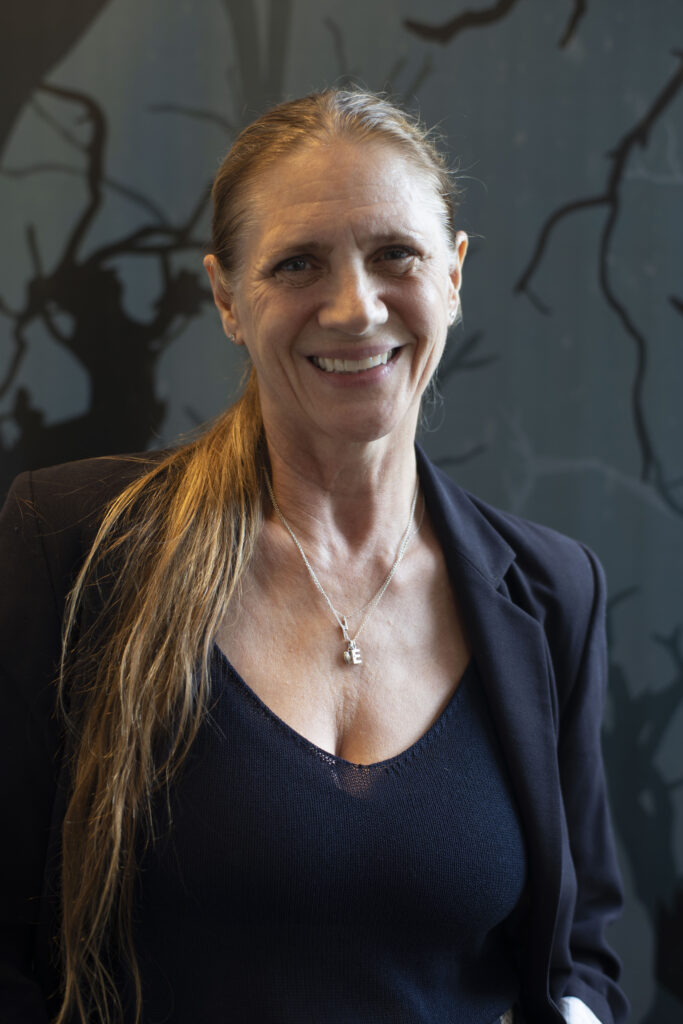
The director of our Best Feature Film winner on adapting a stage play during the pandemic, keeping performances fresh and finding the film in the edit.
Invincible won Best Feature Film at the 2026 Stafford Film Festival. Adapted from Torben Betts’s stage play, it is set during the 2012 recession against the backdrop of the Afghanistan conflict, the European Cup and the Queen’s Jubilee. Emily and Oliver have left their comfortable London lives in pursuit of something real in a struggling northern English town, and invite their new neighbours, Dawn and Alan, over for the evening. What begins as a casual gathering unravels into a clash of culture and politics.
At 109 minutes the film could not fit the screening day programme, but director Emma Croft joined us at the Mitchell Arts Centre and talked to festival founder and director Michael S.U. Hudson about making her first feature.
- Film
- Invincible
- Directed by
- Emma Croft
- Written by
- Torben Betts
- Produced by
- Samantha Seager and Emma Croft
- Award
- Winner, Best Feature Film, 2026
- Country
- United Kingdom
- Running time
- 109 minutes
The interview
You worked on a feature with a number of actors and quite a complicated story. As a director you build a picture in your head through the script and rehearsals, and then on set, when the actors are live, you discover something different. What did you discover?
That’s a big question, and there are a lot of answers to it, because the process of making Invincible was perhaps different from making a script I had written. It was a passion project. I directed it, and Samantha Seager and I produced it together.
It started as a concept in 2021, during the pandemic, when Samantha thought, as a lot of people did, how do we keep being creative, how do we keep pushing forward? As an actress she wanted to do something, and I wanted to make a film, so we got together. Invincible was her idea. She came to me with the script, and I had never seen it on stage. It’s originally a stage play, brilliantly written by Torben Betts. When I looked at the play, I could very much see how I wanted to turn it into a film. It was perhaps a different process from some films, because three of the actors had actually played those roles before.
Was that a real challenge, given they had already been through the performance?
Definitely. But I had never seen it, it was ten years on, a long time afterwards, and I wasn’t interested in what they’d done before. I saw the film I wanted to make, which is the film you’ve seen.
So how did you clear out the character work and ideas they had built up?
Well, I didn’t know what they were, for a start. We did read throughs, and I brought it down. I worked with each actor a little individually and gave them all something very different to work on, so they weren’t all looking at the same thing. They all brought something very different to the piece because of what I’d given them, which I won’t say.
Because we were still in the pandemic and under quite a lot of restrictions, a lot of it was working with people on Zoom. We did a few rehearsals, and I was able to spend time with Laura Howard, who plays Emily, and Daniel Copeland, who plays Alan, and with Samantha as well. Torben asked if we would consider him playing Oliver, because he had originally written the character with himself in mind, and I thought that was a really good idea.
So that was the cast, and they were all fantastic. On set you have the opportunity to guide the take, do it again, do all sorts of things with it. Depending on which shot you use you get something different, and you can change it in the edit as well.
Some directors do 20 or 30 takes and it becomes obvious the life has drained out of the shot. You were working with people who had performed this material together before. How did you keep the energy high, so the performances felt like reaction rather than anticipation?
As indie filmmakers you’re working with such a tight budget, no budget, no money, and everyone is pulling together, so the stakes are high and everybody is aware of that. Every time we called action, everything was done to make sure the support was there and the energy was there for everyone to deliver as best they could.
We did very long takes sometimes, and we’d let the actors have a run at it with everyone supporting each other. If it was someone’s close up, the others gave as much as they could to that actor. It was never accepted that anyone would just clear off while someone was delivering their close up.
The actors were absolutely brilliant. Sometimes it was a case of bringing the energy down a little. The energy was always internal for them, about being present. They were just talking to each other.
Every filmmaker I’ve met says they hate the first edit. It’s pretty much an assembly, and you look at it and ask where the heart of what you’re trying to find is. After that first assembly, were you happy, or did you have to reassess where the heart of the story was?
There was a lot of material. My editor, Edmund Swabey, sent me away while the first assembly came together. He said, you’re so close to it, step away for a little while and come back when we’ve got an assembly. And you’re right, the first edit is always, oh my God, what did I do, what happened to the film I was making, where is it?
But we have a great relationship. We’ve worked together for four or five years now, on another short film, a short we’re finishing at the moment and other projects as well. That was developed through sitting next to each other for two years editing Invincible. He does all the buttons. We built it by trusting each other. If a scene wasn’t feeling right, if it didn’t have the comedy or the emotion we wanted, we’d always break it down. What’s the scene about? What’s the thrust of it? What’s that character saying? Or, as the director, what do I want this scene to do? What’s its job? Then we’d go back and look at it again.
Sometimes it’s very hard to cut something you like a lot, and you just have to let it go. We cut out 45 minutes. It was running at about two and a half hours in the beginning, and we brought it to an hour and 49 minutes. That took a long time, we did quite a lot of versions, and a few scenes were tricky. When I watch certain things I still feel that. But that’s learning as a filmmaker. It was my first feature film.
Making a film in a pandemic puts pressure on you. I did the production design as well, which wasn’t something I intended to do. I was a carer for my mother for a long time, so I was able to move around during the pandemic, and going back and forth to my mother’s I started gathering the furniture and pieces that created Emily’s home. The house we filmed in was emptied, and I created Emily’s home in that space, in one room that’s two rooms put together. That helped a lot in creating the world, and whenever we had to come back to the geography of Emily’s home in the edit, that geography helped us too.
COVID caused a fundamental shift for a lot of filmmakers, in the way they saw the world and in their cinematic language. Your film started during COVID and carried on until almost after it. Looking back now, has your cinematic language changed fundamentally since Invincible, or is it still tied to it?
I very much want to make something very different. The way I tell stories is inherent in me as a filmmaker, and as an actress and a writer, and I wouldn’t say that’s changed. But the platform of Invincible, within the confines of the pandemic, and then the confines of saying we’re going to make a film essentially in one room, gave the film the opportunity to be explored in a way it might not have been under other circumstances. It wanted to have a feeling of walls closing in, of these people stuck within their lives next door to each other, without much of a broader world than that. In a way the pandemic gave the film that opportunity.
I like working with actors, and with pieces that are character driven. That’s fundamental to me as a filmmaker. But having made a feature film, my whole process has shifted, and I can see ways of making new films I might not have explored before. Making Invincible was one situation, and another film is going to put me in another, where I can make something entirely different in lots of ways but with the same fundamentals: character driven, with a basis that is really real.
I can’t see myself making something for 45 million with spaceships, although I wouldn’t mind if someone offered me that. It would still be characters telling a story everyone can relate to. That’s my lane.
Watch the trailer
Invincible won Best Feature Film at the 2026 Stafford Film Festival. Read the full credits on the film page and see every 2026 winner.